

A support pod on your terms
Because you'll always have needs.

Notes from the Inflection Point explores climate grief, action, and adaptation. In a voice dedicated to seeing things afresh, again, and with agency, we offer readers reflections most Thursdays.
The Eaton Fire devastated the foothill community of Altadena this January. Few think of the wildlife, the land, the crops, the water that would now be coated in asbestos and ash. Most focus was on the affected people.
As of July 22, 2025, the death toll from the Eaton Fire included 19 people with 22 people still unaccounted. About 9,418 structures were destroyed, including 4,356 single-family homes, 77 multi-family buildings and 123 commercial buildings.
This amounts to about half of all black households in the area.
With a bickering federal government, hundreds of Angelenos came together to help the affected families. Jorge Trujillo of Pasadena said a couple weeks after the fire started: “I haven’t seen one government car out here giving food.”
While attention and support has waned since January’s fires, some have been stalwart.
The other day, I was invited to facilitate a play session with fire-affected communities. Everyone I spoke with was still displaced (it is September). My session was about world-building. What kind of world do they want to create? They could choose anything. Later, we’d discuss small ways they could begin to create that world.
This group of systematically failed survivors wanted to build “peaceful world,” where everyone’s needs are met and no one needs help.
When I offered that yes, everyone should take care of themselves and sometimes that means taking care of others, I was gently and roundly corrected.
“You can only ever count on yourself.”
“You need to take care of yourself first.”
In a minister’s backyard, as wellness providers—reiki, massage, energy healers, yoga teachers, acupuncture, and a sound healer—swirled around them, stuck them with needles, worked their muscles, the group patiently informed me that “peace” does not come with or through other people.
How many of us are comfortable saying “I need...” without feeling shame or weakness? How many of us love feeling efficacious—like we can do things ourselves? How many of us even have someone to discuss these vulnerabilities with?
About a third of people in the United States report having 1-2 “close” friends, one of whom is often their partner, somewhere in the world. Amid a changing socioeconomic and political structure, amid a changing climate and more frequent ecological disasters, many people entirely lack a support structure. No wonder the displaced residents insisted on self-reliance.
At the same time, I personally observed their gratitude for receiving care from volunteer providers. I really think this is a matter of view, speech, and social practice.
What if I told you there are practical frameworks for building your own social support networks for both everyday and crisis needs, based on respect for both individual agency and group needs?
SOIL: A Transformative Justice Project spearheaded by queer transracial adoptee, disability and abolition activist Mia Mingus, defines a pod as a small group of people gathered around specific needs.
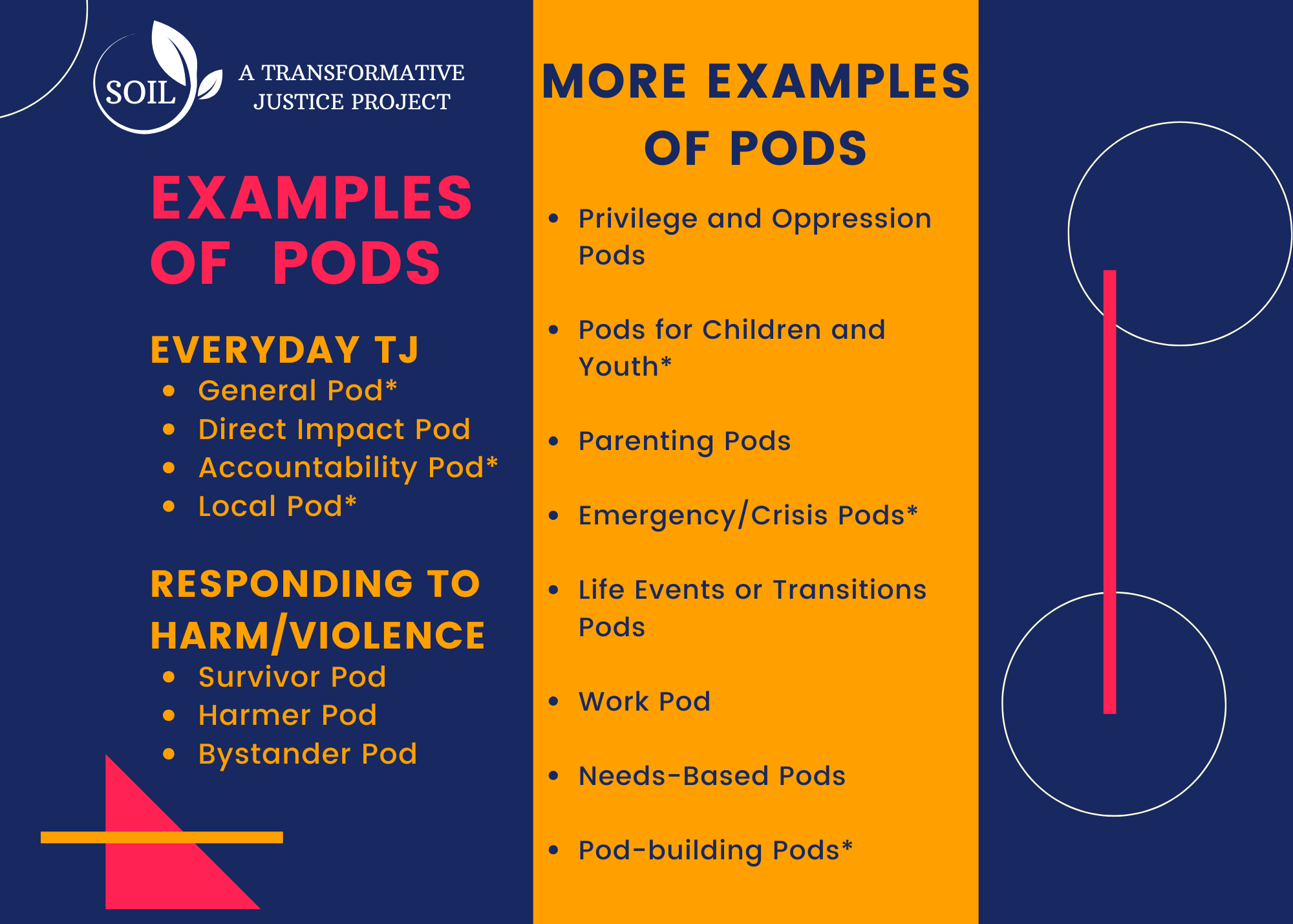
One major difference between a friend group, family, co-workers, and a pod is an agreement to communicate on a periodic basis about needs, vulnerabilities, and capacities. Often, there is a shared why. The SOIL site offers several—to prepare, to build communities of active care, to fight isolation—but leaves it up to your group to define.
Each can be created based on changing group members. For example, your everyday pod (think accountability group) might be different from a group of neighbors that agree to help each other if a hurricane hits or a wildfire bears down on them. Both might be different from your job-seeking/networking group.
Mingus’ SOIL will host a “greenhouse” for building and refining pods this Saturday.
This is not a workshop or lecture. This is a free, quarterly container for discussion among whatever size pod you have to check-in, align on changing needs, and revise or re-confirm commitment to the group. Does that sound like a lack of structure?
They’ve provided several resources, including a suggested agenda for breakout rooms, five card decks with “General,” low, medium, and high vulnerability questions, and a “healing and accountability” deck to resolve conflicts to guide the discussion.
People that sign up as a group will be put into their own breakout room. Individuals will be put in small “pods” of other individuals to discuss challenges and successes with their pod-building, learn from each other, and possibly form new (likely remote) pods.
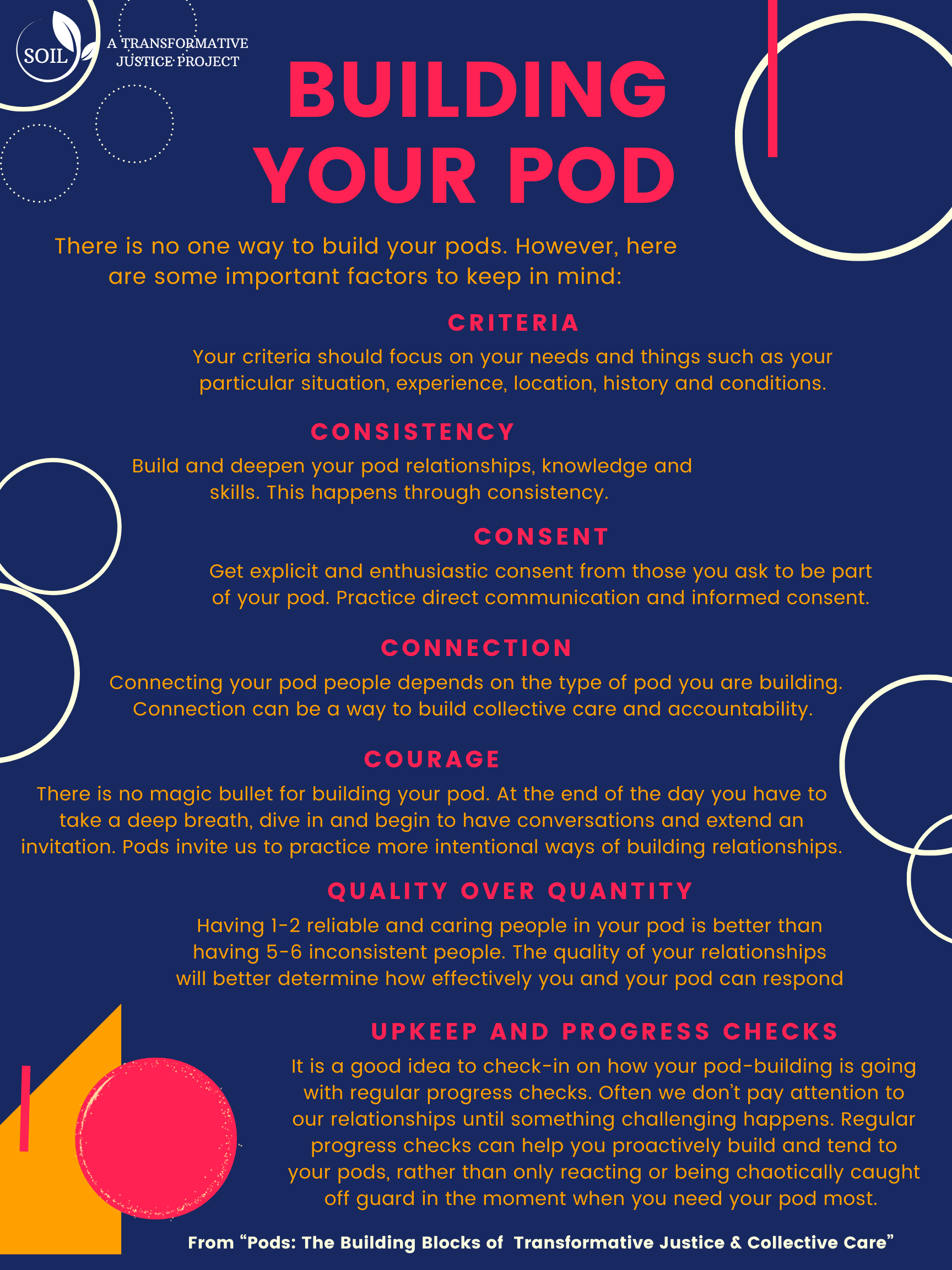
Mingus stresses pods are not quick fixes. These are built through trial, error, compromise, and regular communication. Again, the difference between a pod and a friend group is periodic check-ins. This is a container to avoid needing to say, “We should talk.”
She writes
Pods invites us into a more connected way of living that resists isolation, fear and hopelessness, some of the many factors that allow for harm to occur. If everyone had a pod, imagine how much more resourced and supported we would all be. Imagine how much more accountable and brave we might attempt to be. Imagine what could be possible inside of our communities, neighborhoods, cities and movements for justice.
Trauma responses, social habit patterns, social courage takes time to shift. That’s why dialogue and practice is helpful.
The SOIL greenhouse (free) happens this Saturday. Check out the website for its abundance of resources, including decks, discussion guides, how-tos, and worksheets on starting one.
Again, this is not a workshop. This is a container for your regularly scheduled conversations to build the world you want.
Bio
Logan Juliano, PhD (they/them) is a queer, transracial adoptee with a PhD in Performance Studies and lecturer at the University of California, Los Angeles. They do all the Light Hive things and co-edit Notes from the Inflection Point, where they write to share reflections and practices amid ecological and social uncertainty. Today they are very grateful for the health of their cats, Fischer and Portman.