

Visiting home
And making projections

Notes from the Inflection Point explores climate grief, action, and adaptation. In a voice dedicated to seeing things afresh, again, and with agency, we offer readers reflections most Thursdays.
I’m home in Minnesota for a few days. Stepping into the humid August air is like stepping into a pair of soft, broken-in shoes from the back of the closet, familiar and well-worn. I’m hit with the simultaneous familiarity and strangeness of being in the place I used to live, the effects of time passing while I wasn’t there.
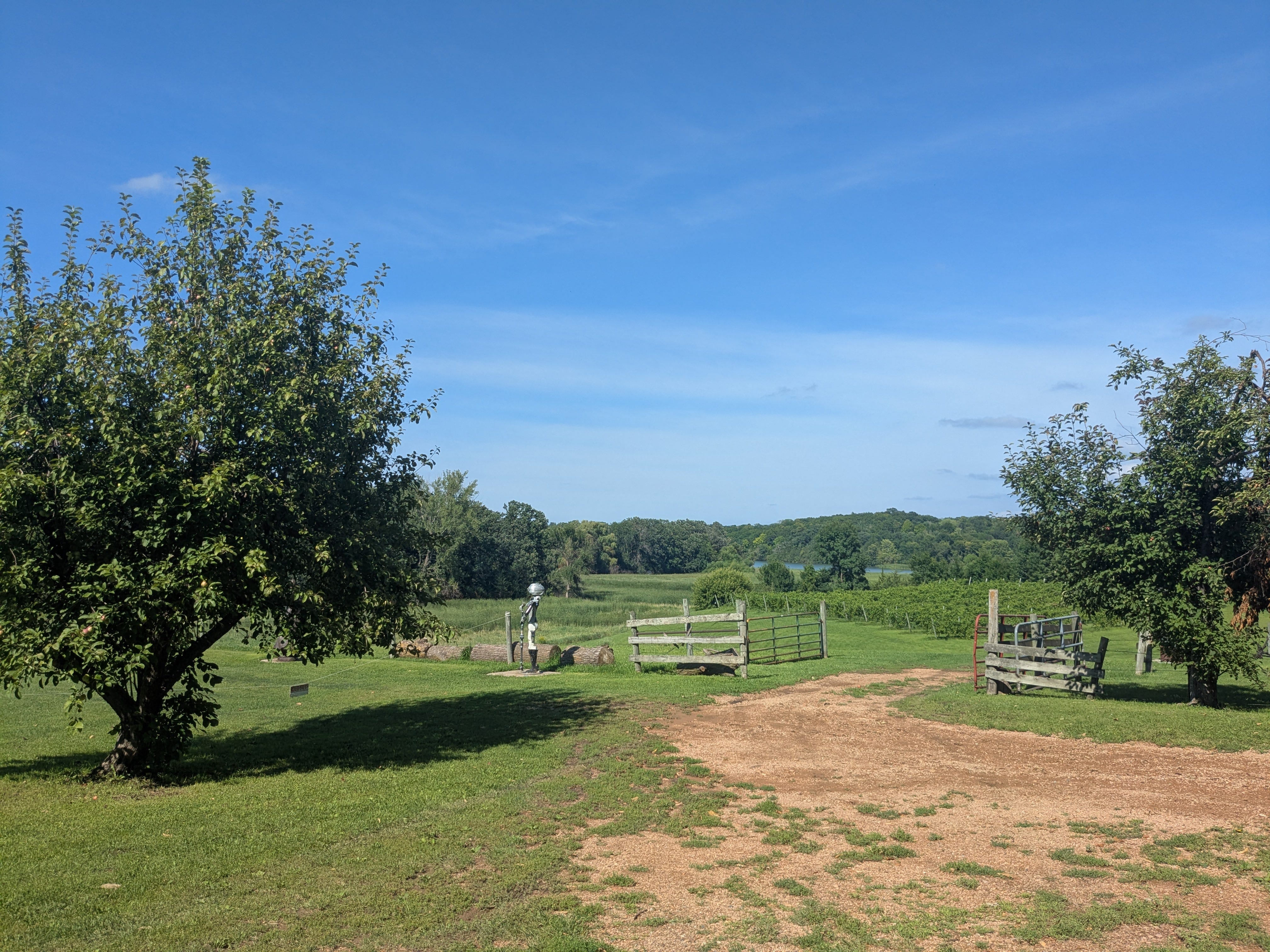
I notice the trees first: yellow-green aspens, maples, and oaks, leaves fluttering lightly in the wind, so unlike the dark, stern conifers of the Pacific Northwest. The sky is hazy blue. My dad’s car breaks down as soon as we try to get on the highway, and I soak up the heat like a clay pot baking in a kiln as we wait on the pavement.
Later, surrounded by mosquitoes and the syrupy buzz of cicadas, I walk through the woods along the Mississippi River with my mom. We see an artist’s palette of primary-colored songbirds (cardinals, goldfinches, blue jays) and two deer still young enough that their spots haven’t faded.
Dense clouds, dark and dramatic, gather in the evening, and that night a storm blows through, the kind that develops downwind of almost two thousand miles of sun-warmed continent: a constant strobe of the lightning, hail pinging off the windows, and splitting thunder that rattles the frame of the house.
I go through my memories of growing up here, worn-out and reconstructed like photo slides on an old projector.
One slide: in snowy winter, migratory trumpeter swans congregate in the aerated, ice-free patch of lake in the woods, white on white; I hear them before I see them, trumpeting so loud that I think there is construction work happening in the middle of the woods.
Another slide: steam rising off my sweating hands when I’m out of the wind, perfect snowflakes landing on the arms of my coat, and a pair of ducks swimming through the black water, passing under the wooden bridge I’m standing on.
In the middle of summer, a dead goose on the edge of a spit of sand jutting into the lake takes me by surprise, all alone in the quiet noon sunlight. Tan and green grasshoppers spring constantly from sunbaked gravel paths, fleeing at the last minute before I nearly step on their previously invisible bodies.
In the marsh, striped bluegills zip under the surface, while frogs scream just out of sight. I see tiny tadpoles and bugs darting in the water when I crouch down close.
At the river, a rare bald eagle circles in a column of rising air; I lock eyes with a tawny deer in the tall yellow grass on the shore, the two of us watching a front move in, a wall of dark clouds rapidly closing the distance between us.
As comfortable as it is visiting home, it hurts hold the slides up to the light. These familiar images are skewed now, misaligned with what I see, like a slightly off-center screenprint. The gravel paths are now paved, though the grasshoppers still fly up from them like firecrackers. In the marsh, carp nose around instead of bluegills, their foreheads breaching the water like tiny whales. The woods continue to shrink.
What will it look like ten or twenty years from now? I don’t know. But the deer are still here, and the storms, and the artist’s palette of birds, for now; and the mosquitoes.
Lou Baker (they/them) is a scientist and organizer. They hold a PhD in Aerospace Engineering and studied how wind and water currents carry microplastics in different environments. They now organize workers in higher education.